Despite promising to block all ads, developer Dean Murphy will be paid a monthly fee to allow some adverts through his filter.The top-selling advert-blocking software on Apple's App Store will soon let companies pay to show you ads.
Apple recently updated its software to allow developers to release apps to block adverts within the Safari mobile web browser.
Crystal quickly topped the App Store charts, with more than 100,000 people downloading the 79p app.
However developer Dean Murphy has now entered into an agreement with a company called Eyeo GmbH which will allow some companies to pay so their ads get through Crystal's filter.
Mr Murphy will receive a flat monthly fee from Eyeo on top of his App Store earnings.
Many of the people who'd downloaded the app said they were disappointed by the move.
One Reddit user called Wackywabbit wrote: "So it's not actually an ad block? Sellouts."
Another said: "I've deleted Crystal and left them a one-star review."
Mr Murphy hit back in a blog post, saying that only adverts which are not "annoying or disruptive" would appear.
He said: "Blocking all advertising with brute-force doesn't promote a healthy mobile web that is sustainable and allows publishers to make a living from the free content they provide."
He added that the 'whitelist' of permitted adverts could be turned off, however it is likely to be on by default.
Yesterday's post posed a question - could you build the next business like Dre?
The reality however is that most people can't or perhaps simply won't. However bad their desire to change their lives, there are no actions taken to put that into effect.
I have been involved in online business for a number of years and have also advised clients in my other role as an accountant. What is clear from seeing through so many start ups is that business can be difficult - or at least it is in getting started. You have to raise capital, get a product ready for production or publication, arrange the graphics, then work out whether anyone actually wants it by test marketing, then work out how to properly market it to let people become aware of it and ensure they want it, then arrange for a payment processing system, then arrange for delivery, buy necessary materials, store them or the finished product etc etc
No doubt these issues have already been in your head. How many businesses have you nearly started? How many ideas have you had which you've told yourself are great ideas but then done nothing?
Which is why I'm very excited to share with you an idea which can solve this very problem for most people which can take out so many of the starting issues.
This is a business concept which is arguably the most significant trend of the last 5 years. It involves:
Completely online so you can work from the laptop by the pool if that's your thing
All products are downloadable so no stock and no delivery
Growing product base of online business tools to sell so there will be no shortage of angles to sell to customers
Well-staffed support desk
Ready made sales pages
Telephone sales (low pressure) team to follow up on all leads - improving the conversion rate massively
Front end commissions of up to 90% of sales price - ensuring you can earn up to $1250 per sale
Ready made back-end products to ensure you can access high paying commissions of $3300 and $5500 and even higher in some cases
All aspects of the business are effectively done for you. All you have to do is direct the traffic! No product creation, no conversions, no follow up (unless of course you want to)
This really is one of the most exciting online innovations of this decade. It could just be your best ever chance to do something and earn that financial freedom you've so long coveted.
“I created a monster!” That’s a line from an Eminem song—one of Dre’s most famous protégés. And a monster is exactly what legendary hip-hop artiste, producer and entrepreneur, Dr. Dre, created with his iconic headphone brand, Beats by Dre.
In May 2014, Apple Inc. purchased Beats Electronics for a ground-breaking $3B; the largest acquisition of its kind. Dre’s 25% stake left him with a ‘get-ready-to-gasp’ $500 million windfall and a ‘holy-Forbes’ net worth of $700 million.
What’s stopping you doing the same? It’s possible because there’s precedence. Dre’s done it. Jay-Z is doing it. Why can’t you?
If you have an idea or a newly formed business, make it reach the dizzying heights of Dre’s dollars:
The Idea
You need that eureka moment! It’s when the ‘million dollar idea’ comes to you with compliments from the cosmos. You begin to see this new business idea as your destiny. You’ve heard all those success stories before–“Mr. Rich Man made his millions from his bedroom” or “Entrepreneur stumbled upon an idea after falling into a ditch and thinking of awesomeness on his way down.”
If you’ve waited long enough for that idea to come to you, then perhaps force the issue. Just a little.
Look carefully at your current business. Are there certain areas that don’t run as smoothly as you would like? Maybe you have a solution, something that hasn’t been conceived yet? After all, great inventions are solutions to problems we may not have realised existed.
Once you have your idea, work on it. Run with it. That’s how Beats was born.
During a business brainstorming session, Dre’s lawyer recommended that he sell sneakers. Dre’s business partner and iconic record producer, Jimmy Iovine, allegedly suggested otherwise; “F*** sneakers, let’s make speakers.”
However, Dre was apprehensive thinking headphones wouldn’t work. Competitors such as Apple had huge success with cheaper headphones. Dre didn’t believe people would want to spend a significant amount of money on a much more expensive set. But then fate intervened:
One fine afternoon, when observing his children listening to some of his own beats, Dre said, “It was crazy to see my kids listening to my music on these headphones. I was like, ‘This is not how it’s supposed to sound. This is not what I spent all this time in the studio for.’ We decided we had to do something about it.”
He ran with the idea. And a billion dollars later, it turned out to be a good one.
The A Team
When your business idea begins to flourish, be sure to organise a team of ‘A’ players. The best possible recruits for your business in its infancy will enable a solid foundation upon which to build a successful future.
In May 2014, Beats hired Matthew Costello, the new Chief Operating Officer. Formerly of IKEA and HTC, he arrived with a pedigree that matched the company’ vision. However, hiring somebody that has a high level of demonstrable experience may not be the easiest thing to achieve for a small business, especially a start-up. So, setting up a precise interview test or trial run may be the best option in order to find the candidates with the best ability.
Marketing Your Monster
On a scale of 1 to 10, marketing ranks 11 for importance. Market your product effectively and you’ll earn yourself a customer.
The 2014 television campaign of Beats managed to create a frenzy with cameos of famous celebrities including, Serena Williams, Nicki Minaj, Kylie and Kendall Jenner.
You’re most likely at the stage where you can’t afford the big campaigns that major blue chip companies so lavishly execute. And that’s fine. But just be sure to budget enough money to go as ‘all out’ as you can in order to draw the world’s attention to your company.
The ‘A’ team counts here too by the way! If need be, hire the best marketing company to help you launch your service in a creative and effective manner.
Aim for More
As an entrepreneur, you should be unaccustomed to ‘resting on your laurels.’ Always think one step ahead of your next move and ask yourself how you can exploit your latest success.
If you’ve successfully been selling a particular service for a very long time, think of ways in which you can exploit and expand on that. Perhaps consider add-ons to a certain product or running free ‘taster’ trials for your next launch. Whatever it may be, you must not stagnate. Keep those profit lines rising.
Beats Music, a subscription-based online music streaming service, was launched in January 2014 with an intention to provide a different type of streaming experience to what was already available. Ian Rogers, chief executive of Beats at the time, said, “We wanted to build a music service that combined the freedom of an on-demand subscription service—unlimited, uninterrupted streaming and downloads of tens of millions of songs – but layer on top features that would give you that feeling only music that moves you can give.” This was all possible due to the success of Beats by Dre; further expanding the brand. “Ex-branding” if you will.
Now take your business idea and aim for the $3B dollar mark. If you aim low, you’ll never be big.
Twitter experts, marketing pros and business leaders share their top tips on how to turn 140 characters into online marketing gold.
At the time of its SEC filing in early November 2013,
Twitter had more than 232 million active monthly users, 53 million of which
were in the United States. That makes Twitter a potentially powerful marketing
tool -- if you know how to use it.
Twitter, Twitter tips, Twitter marketing tips
So how can you leverage the popular 140-character social
media site to drive more traffic to your business or website? Dozens of Twitter
experts, marketing pros and business leaders who have used Twitter to market
their brands, products and services share their top 14 tips for how to
successfully market your business on Twitter -- or employ Twitter as a
marketing tool.
1. Optimize your Twitter bio. "Make sure your company
identity and voice are branded well," says Jon Ferrera, CEO, Nimble, a
provider of social CRM. That means having a bio that tells people who you are
and includes a link to your company website or a landing page -- and having
"a consistent tone so that people clearly understand who you are and what
you do."
2. Find out who the influencers and experts are in your
target area(s) and interact with them on a regular basis. "Use Twitter
search or a tool like Topsy [or Followerwonk] to find like-minded prospects,
customers and influencers/media by searching keywords that relate to your
industry," says Stacey Miller, social media manager at cloud marketing
provider Vocus. Then follow and interact with them on a regular (daily) basis.
"Make a list of the 100 most influential people in your
space -- journalists, thought leaders, potential clients/customers, big-name
bloggers and writers, potential partners, etc.," says Shanelle Mullin, the
director of Marketing at Onboardly, a provider of PR and content marketing for
startups.
"Add them to a private Twitter list and engage with
them daily. (Tools like HootSuite make managing this process much
easier.)" And remember to "be casual [and helpful], not
promotional," Mullin says. "Build a real relationship and then look
for opportunities to collaborate."
3. Get colleagues involved. "The first people to help
build your brand should come internally," says Amanda Cohen, marketing
coordinator, Homescout Realty. "Make sure your coworkers are following you
on Twitter and tweeting, retweeting, engaging, etc."
4. Tweet regularly. "Regular tweeting is a sign of an
active, healthy profile," says Sandra Fathi, founder & president,
Affect, a public relations and social media firm. "If you only tweet once
a week, or once a month, you aren't keeping up with the Joneses [or the Twitter
equivalent]. Worse, folks will forget about you," she says.
"I recommend daily postings and engagement so that you
are top of mind on a consistent basis," Fathi says. Just be sure you are
tweeting relevant or useful information, content your followers will read, click
on, retweet and/or favorite.
5. Don't be afraid to ask for some Twitter love. Ask
followers to retweet, mention or favorite your tweets -- or to share content
with a fresh tweet.
6. Track mentions -- and respond if appropriate. "Track
brand mentions and keywords to make sure [you know what's being said about
you]," says Vikram Bhaskaran, director of marketing at Freshdesk, a
customer support Software-as-a-Service (SaaS) solution. And be sure to respond
in a polite, professional manner if appropriate. "After all, customer
service is the new marketing!" And many customers now post their product
queries and complaints on Twitter.
"Set up Twitter searches for terms relevant to your
brand," adds Ginger Geoffery, director, Social Marketing, The Mac Groups,
a social media agency.
"Monitor the conversations in that search and jump in
to the conversations when appropriate," Geoffery she says. "For
example, say you're a dentist in Buffalo. You could set up a search for the
term 'dentist Buffalo.'" Then, when "you then see someone in Buffalo
tweet 'I need to go to the dentist but it's so hard to get an appointment,' you
could jump in and [tweet], 'We'd love to have you as a new patient.'"
7. Retweet. "Don't be afraid to retweet as this will
help link you with and cement your own thought leadership within your
industry," says Mark Rushworth, head of Search at Blue Logic Web, a Web
services provider.
8. Favorite tweets. "Many people don't know about
favoriting tweets, but it can get someone's attention more than a retweet or a
mention," says Amy Marshall, COO, Fathom, a digital marketing and
analytics agency.
9. Follow trends/hashtags. "Look at the trending topics
and hashtags and find a way to make a relevant connection to your brand,"
says Crystal Cantabrana, director of Operations, Grizzly Group LLC, which
provides social marketing solutions. "By putting your business among the
trending topics, your handle will be seen when people search tweets regarding
that particular hashtag."
"Tagging our posts with one or two relevant and
trending hashtags has [helped us] to reach new users," says David M.
Burrows, vice president of marketing & PR, Cinsay , an online video
commerce company. However, "hashtags should be used sparingly, as they can
be seen as 'Twitter spam' when over used or attached to irrelevant
content."
10. Offer discounts or special deals to Twitter followers.
"Run Twitter contests such as: 'The next 50 people that retweet me will
receive a coupon for 50 percent off,' or have people post pictures of
themselves in the store or using the product and do a random drawing,"
suggests Marshall.
11. Use images and videos. "Get visual," says John
Lee, manager, Brand + Social Marketing, Webtrends, a digital marketing
solutions provider. "Photos and videos drive three to four more clicks on
Twitter."
"Images, videos and other rich media have proven to
receive more views, clicks and shares than plain text tweets," says Marko
Muellner, vice president, Marketing, ShopIgniter, a social performance
marketing platform.
"While community managers may be doing a great job
engaging followers, a banal post about enjoying the weekend is much less
effective than rich, in-stream content in which someone can, for example, view
a film trailer and find out where the movie is playing in their
neighborhood," Muellner says. "In fact, research shows that rich
tweets have significantly lower negative feedback rates as consumers appreciate
interactivity and content designed for their social mobile context."
12. Use Promoted Tweets. "Be sure to directly target
your audience with Promoted Tweets," says Bryan Shaw, community manager at
3dcart, an ecommerce platform. "Failing to define exactly who you're
trying to reach [could] cost you time and money."
Just "be sure that your promoted tweets aren't
spammy," says Aaron Endré, a marketing and PR expert helping B2B tech
startups. "The goal is to provide value that establishes trust and
credibility, not trick people into clicking a link."
And "Keep it fresh," adds Alicia Antoniolli,
account manager, Social, 3Q Digital, a digital marketing services provider.
"Make sure your promoted tweets don't run for too long." If you want
to continue to get that message across, find a slightly different way to say
it.
13. Make sure Twitter is integrated with your other
marketing efforts. "Twitter, like other social media platforms, is much more
effective when integrated with your other marketing activities," says Mark
Schmulen, general manager, Social Media, Constant Contact, an engagement
marketing company. "For example, if you're running a promotion or contest
on Twitter, let your email subscribers know about it, as they are another
customer base who have already let you know that they want to receive messages
from you," he says. "Inversely, by occasionally tweeting out the link
to your mailing list, you can also tap your Twitter base into your email
content."
14. Use Twitter analytics. "Use Twitter's native
analytics daily to get a grasp on what's resonating and what's not with your
audience once you've built it," says Miller. "In the analytics
dashboard, you'll be able to tell what your best days to tweet are, the types
of content that are more favored and the demographics of the followers that
you're attracting," she says. Then you can "replicate what's working
and rework or reevaluate posts that aren't."
Jennifer Lonoff Schiff is a contributor to CIO.com and runs
a marketing communications firm focused on helping organizations better
interact with their customers, employees, and partners.
If you’re keen to promote your business but find Facebook confusing, you’re not the only one.
“I created a Profile for me so why not one for my business?” A friend made the mistake of creating a Facebook Personal Profile for her cafe.
Before thrusting your business, banners flying, into a Facebook Profile check out Facebook Fan Pages. Here’s why.
Facebook Profiles are for real people.
In fact the Facebook Terms and Conditions state that Facebook may delete a Personal Profile used for business purposes, friends and all. Worth the risk?
Facebook designed Fan Pages for businesses (or organisations, public figures, etc) and your business will get a lot more from its Facebook Page than a Profile. Just to clarify – a Profile gathers Friends where a Facebook Fan Page attracts Fans who Like your page.
Set up your Fan Page well and things could very easily get out of control.
5 Reasons to use a Fan Page, not a Profile
Insights & Analytics Behind your Facebook Fan Page sits easily accessible Insights data about who ‘Liked’ your Page, how they interacted with it and which content was most viewed.
Search Engines Search engines index Facebook Pages so your customers can find you.
Limited to 5,000 friends Your Personal Profile has a limit of 5,000 friends but your Facebook Page has no limit on ‘Likes’.
Promotion & CompetitionsFacebook allows you to promote your business and run competitions on your Facebook Page, unlike your Personal Profile. Facebook does police this one.
Convenience You can assign more than one person to administer your business Fan Page from their Personal Profiles. Wait there’s something else…
Credibility To your Facebook-savvy customers (and the number is probably significant or you wouldn’t bother) a Personal Profile for your business may give the impression that you don’t know what you are doing. Probably not the image you want to project.
So don’t make the mistake of creating a Facebook Personal Profile for your business as switching to a Fan Page later on is not straight forward.
What does Facebook have to say on the subject?
Pages are for organizations, businesses, celebrities, and bands to broadcast great information in an official, public manner to people who choose to connect with them. Similar to profiles, Pages can be enhanced with applications that help the entity communicate and engage with their audiences, and capture new audiences virally through friend recommendations, News Feed stories, Facebook events, and beyond.
You can create and manage a Facebook Page for your organization from your personal account. Please note that only the official representative of an organization, business, celebrity, or band is permitted to create a Page.
Image from Arts Guardian: Beatlemania, 1965 – Crowds outside Buckingham Palace as the Fab Four receive their OBEs
15 Psychological Triggers to Convert Leads into Customers
Would you like to know how to get more customers who can’t wait to buy your products and services?
It’s a lot simpler than you might think. And the best part is that, as you strive to increase revenue, you actually will be serving your potential customers better. You don’t need to manipulate or hypnotize them into buying. You just need to give them what they want.
The key to success in any business is an understanding of psychology.
All human beings essentially have the same mental triggers that drive actions. In order to influence and understand your customers, you need to know what those triggers are and how to utilize them in your marketing message.
Why?
Because our minds decide what to buy. So if you know how minds function, you have the power to influence the decisions they make. Which is why, although this is a long article, you won’t want to miss the marketing lessons that follow.
Here are 15 psychological triggers you can start using today to double your sales:
1. The Driving Forces of All Human Behavior
All human behavior, at its root, is driven by the need to avoid pain and the desire to gain pleasure. Even when we do something that appears to be painful, we do it because we associate pleasure with the action.
For example, in May 2012, I spent one month dragging a 190-pound sled 350 miles across the second largest icecap in the world in temperatures as low as -40 degrees. Most of the journey was spent in misery and struggle. Yet, I chose to make the crossing because I associated pleasure with the challenge, hard work, and, ultimately, the sense of accomplishment that comes from an expedition of that magnitude.
Firefighters run into burning buildings because they associate pleasure with helping people and saving lives. Likewise, marathoners put themselves through 26.2 miles of misery because they associate pleasure with completing the course.
To use this trigger in your marketing, you need to first understand what your customers associate with pain and pleasure, because not everyone associates pleasure with running a marathon or crossing an icecap.
This is a key point to remember in any marketing message: In order to influence someone, you need to know what already influences them. You find this out by getting clear on who your audience is.
Once you know who they are and what they want, then use the A to Z technique to implement this trigger in your marketing.
Actionable Takeaways
The A to Z technique:
Your customers want to get from point A (where they are now) to point Z (where they want to be).
In your marketing message, your goal is to teach your leads how to move as close as possible to Z before you ask for their money. The closer you get them to Z, the more likely they are to buy from you in order to go the final few steps needed to arrive at their desired end result.
By doing this, in their minds, they start to associate your business with the pleasure they get from the results produced as they arrive at all the milestones between A and Z.
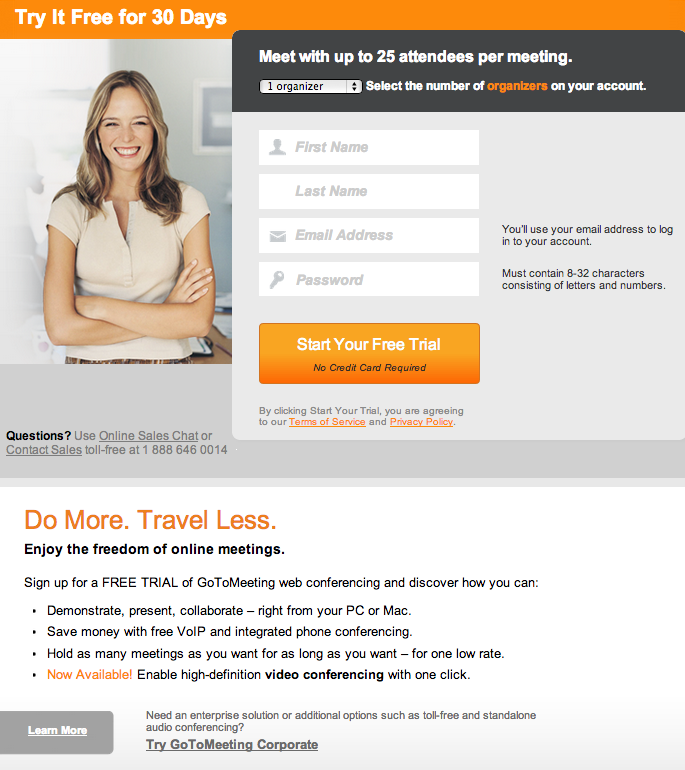
On this landing page, GoToMeeting is promising the “freedom of online meetings,” for free, with no credit card required! They have just taken me to point Y. I am just one step away from point Z.
If I want to get to point Z and enjoy this freedom permanently, then I need to pay them. And I will be far more likely to pay them after having already experienced the taste of the freedom I want.
In contrast, to use the pain motivator, show your prospects all the dangers in the road from A to Z and how your product is the weapon they need to defeat those dangers.
This is an even stronger motivator than the desire for pleasure because we all have what psychologists call “the negativity bias.” We do more to avoid pain than we do to gain pleasure. This works on a neurological level as well. It has been demonstrated that the brain lights up more from a negative external stimuli than from a positive one.
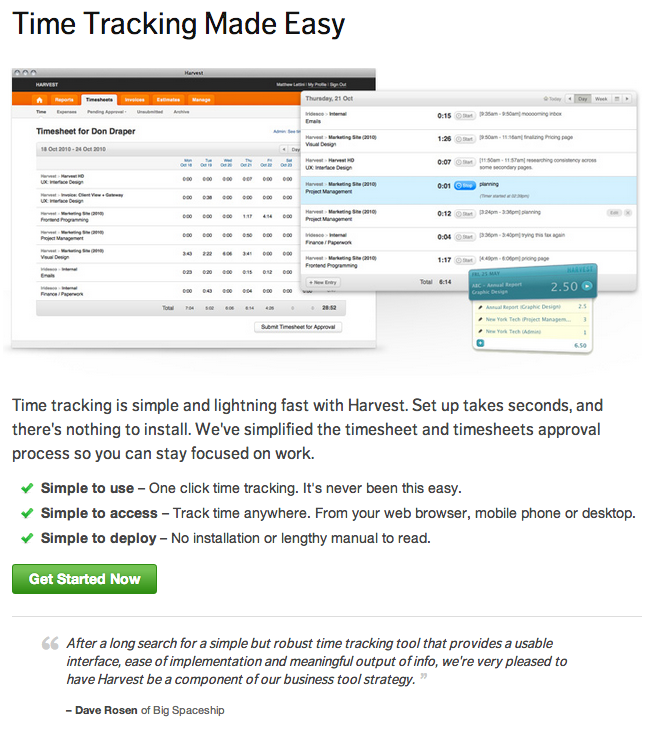
Check out this page from the Harvest time-tracking app. Its marketing message is focused around addressing the pain of a complicated time tracking app. Even their testimonial is a reflection of this pain that they know their audience has experienced. Harvest co-founder, Danny Wen, even says “solve a real pain point, and don’t be afraid to charge for it.”
Having said that, though, in today’s world people are driven by both forces equally when it comes to buying decisions, because there is just so much out there to choose from now that it gets overwhelming. You will want to address both forces in your marketing.
For example, no one really needs an iPad. And we most certainly don’t need an iPad Mini. They don’t solve pressing problems that we as consumers experienced before their release. We were more than happy with our laptops. Yet, people flock to Apple stores at every new release. Why?
Because they address a desire, a want, and an aspiration. They make life more pleasurable.
On a side note, my wife has an iPad and I own an iPad Mini.
Why do you think Apple releases a new iPhone and iPad every few months?
You and I both know that the difference between the older model and the newer one is miniscule. Yet, hundreds of thousands of people toss away their old phones to pick up the latest model.
Why does every single car company release a new model every year? Like Apple, more often than not the differences between models are barely noticeable, yet these multibillion dollar corporations make the effort to release and promote new versions of their products.
That is no accident.
Actionable Takeaway
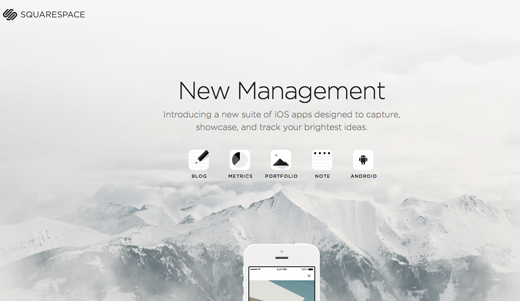
Squarespace recently released a new mobile app, and it is pretty clear in their marketing copy that it is new. Anyone remotely interested in their product will be triggered by this. Without customers even knowing it, their brains will light up at the prospect of investing in something new.
If you want your prospects to buy your products, create new ones, or just make a few tweaks, update the old ones, and rebrand them. You also could combine this with the scarcity trigger to release a certain product once every few months, so that every time it is released it creates a perception of novelty.
Most successful online marketers do this with their information products. They release them it for only a week or so every few months. They could just as easily have the product available for purchase throughout the year, but that would fail to employ the novelty and scarcity triggers, which in turn increase their sales.
Novelty can backfire, though, if you appear to be new in a way that signifies lack of experience or credibility. To address this concern, use this trigger in conjunction with the triggers below, especially the ones like providing social proof, simplifying your solution, and building curiosity.
3. Explain Why
I will sacrifice one hour of my time to give you a free plan to double your income or give you 100 dollars.
What went through you mind as you read that?
You want to know why I would do that, right?
Of course you do. Because our brains are always searching for answers.
In his book Who’s in charge?: Free will and the science of the brain, Dr. Michael Gazzaniga, a psychology professor at the University of California, found that our rational mind is always searching for meanings, even when there is no inherent meaning. Essentially, we seek out explanations to understand everything we experience in life.
In the now famous Xerox experiment by psychologist Ellen Langer, she found that people are willing to do more for you if you give them a reason, even if the reason is completely arbitrary.
People standing in line to use a photocopier were 34% more likely to let someone cut in front of them, even when their reason was as meaningless as “because I have to make some copies.”
Actionable Takeaway
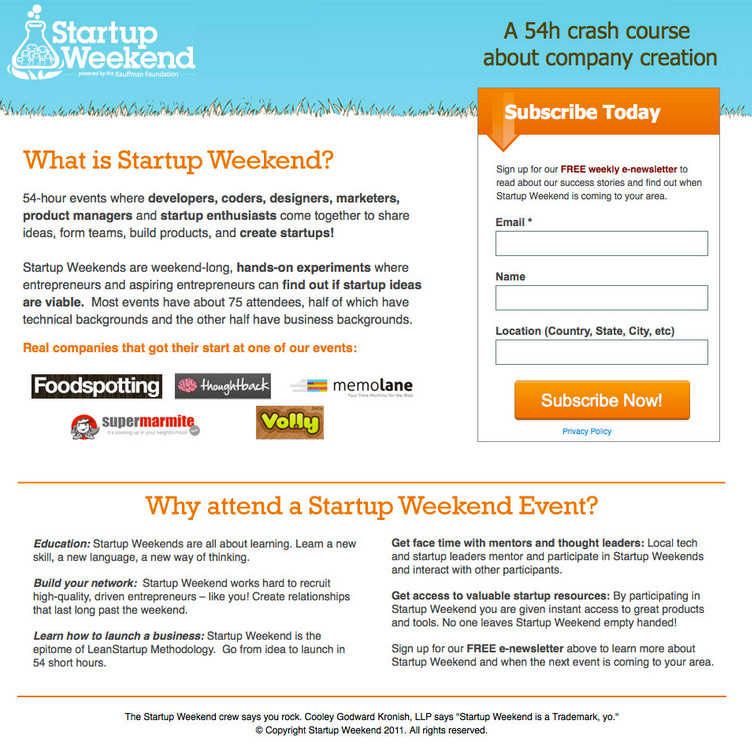
On this landing page, Startup Weekend doesn’t just invite you to attend their event. They tell you exactly why you should and what you will get out of it.
In your marketing copy, explain why you are offering something, and your prospects will be far more likely to comply with your request.
4. Tell a Story
Human beings have been telling stories for thousands of years. It is how messages have been passed on from generation to generation.
One of my favorite examples of telling stories to sell a product is Red Bull’s marketing campaign.
Their product is an energy drink, but their brand is about exploring the unknown and pushing the limits of human potential. They have built that brand and that association in our collective minds by telling stories of people who exemplify the message they want to convey.
Rob Walker, the author of Buying in: What we buy and who we are and Joshua Glen conducted an experiment where they bought hundreds of cheap thrift store items to see if they could sell them by using the power of stories.
They invited 200 writers to contribute fictional stories for each of their products and used the stories to sell them on Ebay.
They raised almost $8,000, making a 2,700% profit. Not a bad return for telling a few stories.
5. Simplify Your Solution
In his bestselling book, Thinking Fast and Slow, Nobel Prize winning psychologist, Daniel Kahneman, says “A general ‘law of least effort’ applies to cognitive as well as physical exertion. The law asserts that if there are several ways of achieving the same goal, people will eventually gravitate to the least demanding course of action. In the economy of action, effort is a cost, and the acquisition of skill is driven by the balance of benefits and costs. Laziness is built deep into our nature.”
We always migrate to the easiest option to achieve a desired result. It is no surprise that Stephen Covey’s 7 Habits of Highly Effective People became a multimillion dollar bestseller. It provides a simple formula to follow to become a highly effective person. All it takes is 7 habits.
Actionable Takeaway
Feed this psychological trigger by creating an easy-to-follow framework for your audience to follow. Show them how your product makes it fool-proof to achieve the result they want in the fastest time possible. Even though we all know deep down that achieving the result we want takes work, we still don’t want to do the work. So give your audience what they want, the easiest and simplest solution, on the front end and teach them what they need on the back end.
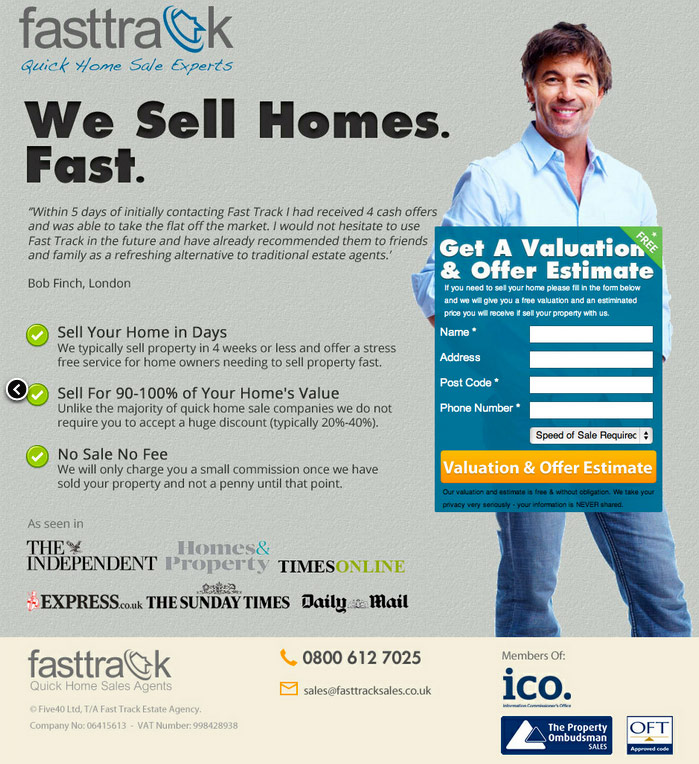
In the above example, Fastrack is telling their audience that they will give them the result they want and they will do it fast.
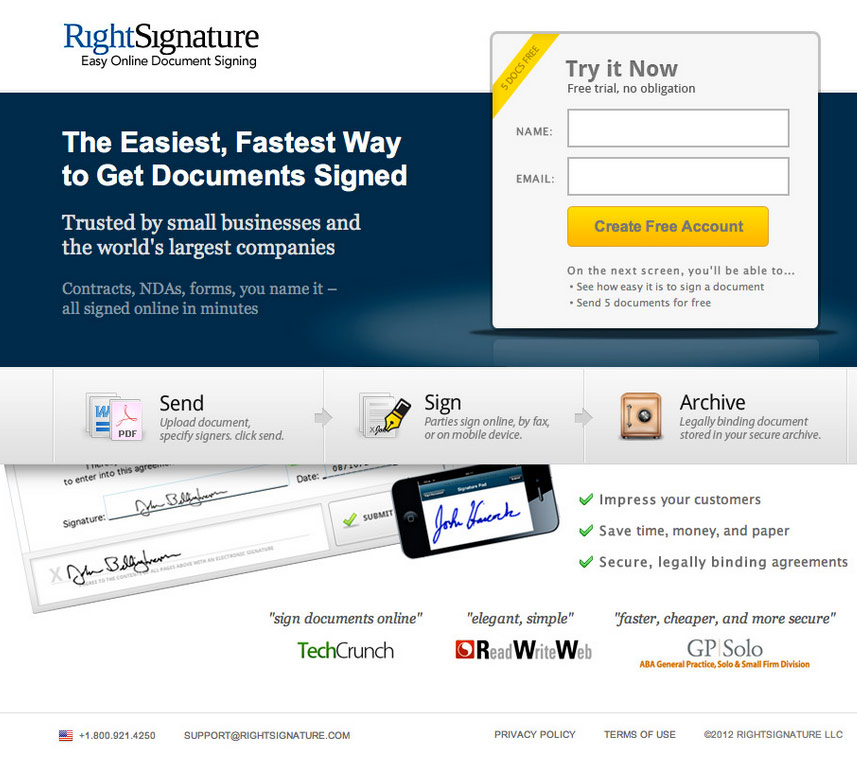
In this example, Right Signature is telling you that they are the easiest and fastest way to get the result you want.
Use words like easy, step-by-step, fast, system, or framework in your marketing copy to let your prospects know that your solution is the simplest one available and they will be far more likely to buy from you.
6. Create a Common Enemy
Create a common enemy and ally with your prospects against it in order to get them fired up to invest in your products and services.
It also allows us to create an explanation for why bad things happen in the world. And remember we are meaning-seeking creatures, so we create enemies to ensure that the world makes sense again. Otherwise, why would bad things happen to good people?
People have even gone to war to stand up against a common enemy, which is why this is a very powerful marketing tactic.
Actionable Takeaway
I know Apple comes up a lot in this article (which is a testament to their brilliant marketing), but they are perfect examples of creating a common enemy to build a brand.
Since their early years, they have turned PC into the enemy, and that is why Apple fans are such loyal brand fanatics. They are united with Apple against the “evil” that is PC.
Here is an old Apple commercial turning PC users into mindless drones:
Here is another more recent commercial where they once again made PC the enemy:
The enemy doesn’t have to be a competitor either. Take a look at this brilliant ad from Careerbuilder.com where they turned coworkers, a boring job, and a mean boss into the enemy:
You have to be careful with this trigger, though. You don’t want to create an enemy that causes people to dislike your brand. It is a good idea to stay away from politics, race, and religion when defining the enemy. Choose something more general or something that most people see as an enemy anyway, like Careerbuilder did with “the boring 9-5 job.”
7. Inspire Curiosity
George Loewenstein, a professor at Carnegie Mellon, discovered that when there is a gap between what we know and what we want to know, we will take action to fill that gap. It is referred to as the Information Gap Theory.
Think of it like an itch that needs to be scratched. Our curiosity not only inspires action, it increases activity in the parts of the brain associated with pleasure as well.
Triggering curiosity will ensure that your prospects open your emails, promote your content, and buy your products in order to fill the gap between the teaser you leave them with and the answer that lies beyond it.
Check out this article from Derek Halpern of Social Triggers to learn more about how to implement curiosity in your marketing.
Actionable Takeaway
There are many ways to pique the curiosity of your audience. To implement this trigger successfully, combine curiosity with the other triggers mentioned in this article.
Here are some examples:
One way is to leave your prospects wanting more by using the driving forces of human behavior in your marketing copy. Give them a taste of how they can achieve their desired result or leave behind their existing pain through your products or services.
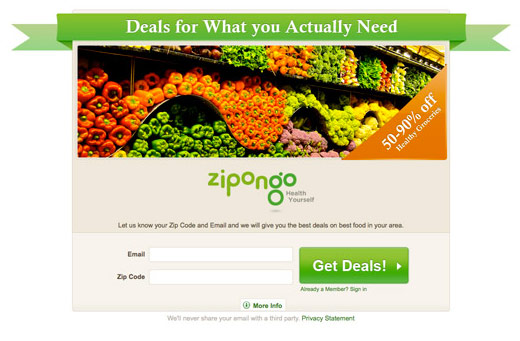
Here Zipongo tells me I can get what I “actually need” and get “50-90%off.” I can achieve my desired result and avoid the pain of paying a high price for it? Perfect!
Controversy is another great way to pique curiosity.
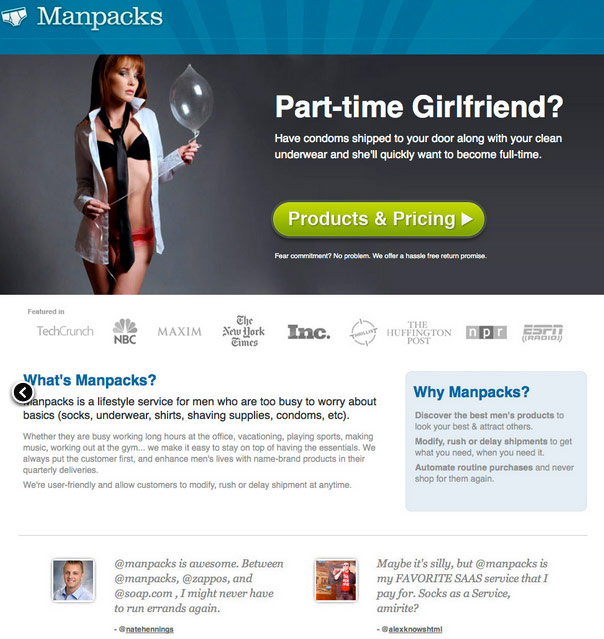
Manpacks does a great job of inspiring curiosity through mild controversy. Without knowing what the service is, just by looking at that picture and reading that headline, most men with girlfriends will be immediately interested in reading more about what they have to say.
Another great way is to ask questions that you know your audience is asking, like Wistia does here:
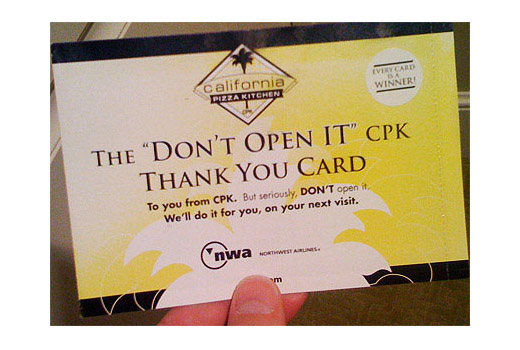
Here is another one:
How much does that make you want to open the card? Telling your audience not to do something or self-deprecating yourself in some way is a great way to inspire curiosity. Some of the highest opening rates I have gotten in my email marketing campaigns are with subject lines like “DO NOT open this email,” or “This is the worst (insert anything you want here, such as sales letter) ever.”
Get creative with this trigger and test out different ways to see what gets you the best result.
8. Build Anticipation
Ever notice how hundreds of people line up for any new Apple product before it is even released?
Why is that?
Because Apple builds anticipation for any new product release.
Sporting events are no different. Weeks before the Super Bowl, hundreds of thousands of Americans across the country plan and prepare for the eagerly awaited event. They tingle with excitement and joy at the thought of opening a beer and watching their favorite teams duke it out for the greatest honor in football.
Gretchen Rubin, the bestselling author of The Happiness Project, says thatanticipation is a key stage in happiness; by having something to look forward to, you bring happiness into your life well before the event actually takes place.”
Large companies like Apple and Canon even have whole websites dedicated entirely to rumors about their products. This builds anticipation for their eventual releases which in turn increases sales.
Actionable Takeaway
Create publicity for your products before they are released to get people excited about them. This will trigger pleasurable emotions that they will associate with your product and eventually buy them when your product is released.
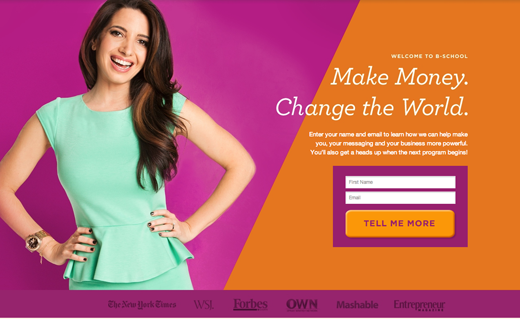
Marie Forleo does this with her flagship product, “Rich Happy and Hot B School.” She doesn’t just announce it, she gets people to sign up so that they can get a “heads up” when the program is released. This gets people excited about it.
Next time you are launching a product or service, create publicity for it in your community by announcing it months ahead of time, getting people talking about it and finding influencers to promote its release as well.
9. Use Social Proof
This is a very common one, but nonetheless a necessary one to mention.
Professor of psychology and bestselling author of Influence: The Psychology of persuasion, Robert Cialdini says “If you can get people who are similar to the person you’re trying to persuade to speak on your behalf, it’s a lot easier for you than if you have to try to hammer your message one more time into a reticent mind.”
Human beings are social creatures. We look to others to determine what actions we should take.
Actionable Takeaway
Show your prospects how much others are benefiting from your product so that they know it works. Use testimonials from your clients or show numbers of how many people use your products to let your audience know that your product produces results.
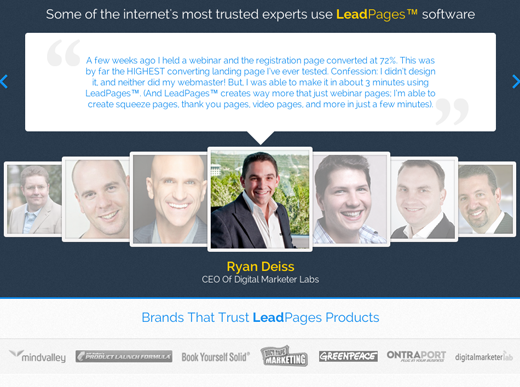
Most of the examples illustrated in this post employ social proof in some manner. Here is another example:
Not only do they use testimonials from other trusted experts, they have logos of brands that use their software as well.
Check out this article for more about how to leverage this strategy.
10. Create References
Dan Ariely, the bestselling author of Predictably Irrational states that “humans rarely choose things in absolute terms. We don’t have an internal value meter that tells us how much things are worth. Rather, we focus on the relative advantage of one thing over another, and estimate value accordingly.”
Actionable Takeaway
All life experiences are judged based on references that we have of previous ones. Create price juxtapositions and offer bargains sporadically to induce a previous reference that makes this new experience worthwhile. This will make people more likely to buy your products.
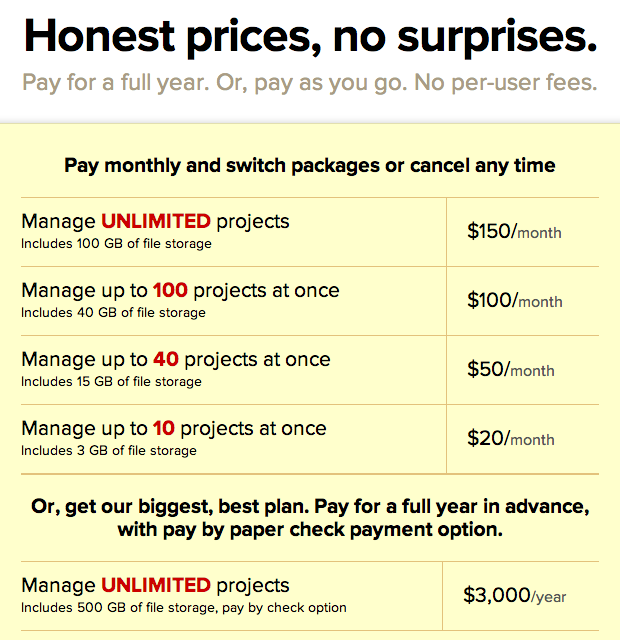
By first showing us the $150 a month price tag, Basecamp creates a reference point that then makes the lower price tag just below it far more appealing.
11. Make Your Potential Customers Feel Significant
We as human beings all want to feel important and significant, not just in our own eyes, but since we are social creatures, in the eyes of our peers as well.
Actionable Takeaway
Make your customer feel important by letting them know you actually care about them, because sadly good customer service is not just a given these days. Try calling Delta airlines customer service hotline and you will know exactly what I mean.
Providing not just good, but excellent, customer service makes your prospects feel like you value them, which makes them more likely to buy from you.
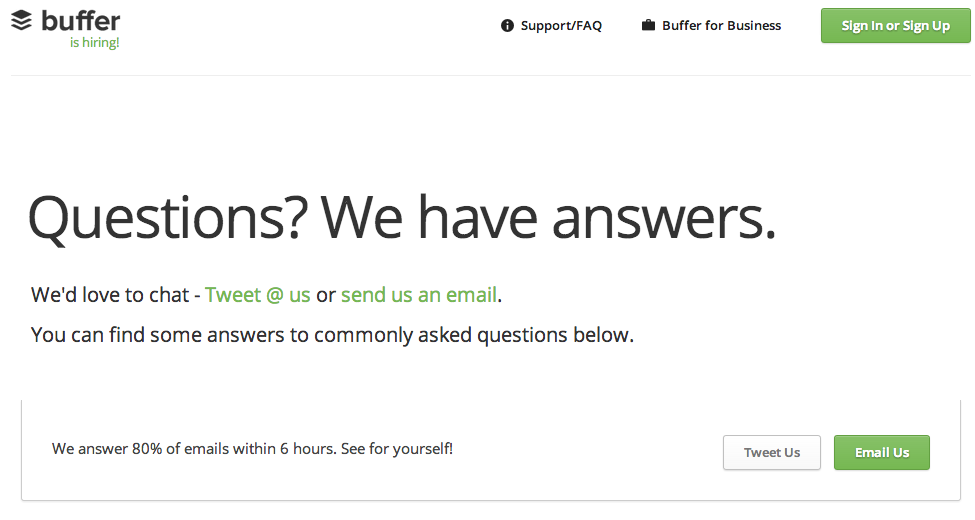
Leo Widrich, the co-founder of Buffer, says “Giving the best customer support possible is at the very top of our list. Like literally, it is the number one thing we want to get done every day.”
On their FAQ page, they rightfully make sure their prospects know how much they care about their customers.
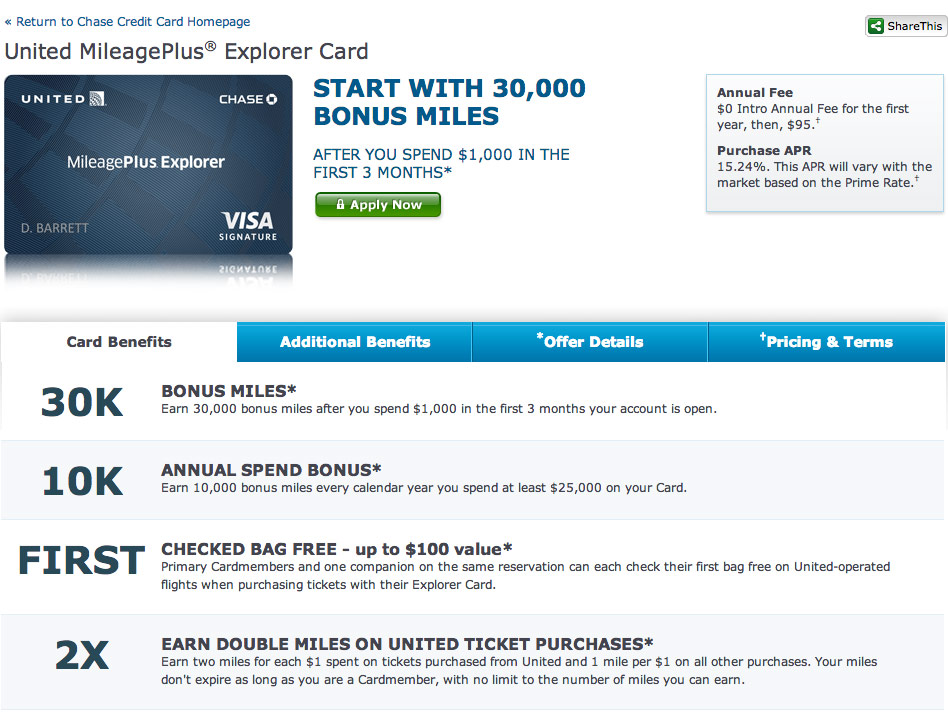
Another way to make your customers feel significant is to reward them the way credit card companies do when you get their card:
By signing up for this credit card, I know I will be rewarded. And, as a frequent traveler, this makes me feel valued by the company and more likely to invest in their product.
There are many ways to make a person feel valued. At its core, the fundamental principle behind this trigger is actually caring for your customer. People know when someone is faking concern. Nothing substitutes genuinely valuing the needs of your customers. Do that and they will love you for it.
12. Build a Community
Aristotle once said “Man is by nature a social animal; an individual who is unsocial naturally and not accidentally is either beneath our notice or more than human. Society is something that precedes the individual. Anyone who either cannot lead the common life or is so self-sufficient as not to need to, and therefore does not partake of society, is either a beast or a god.”
We have an inherent need to be a part of a social community and to feel connected to others. It not only makes us feel secure and comfortable, it inspires us to take action to achieve our desired results as well. So if your prospect feels that your product will help them get what they want, they will be more likely to act and hit the buy button.
Actionable Takeaway
When you sell to a customer, give them something else to make them feel like they are now part of your community. This also builds fanatical loyalty that has your customers proud to be included in your group.
In the book, Sinek references Apple’s “why” and how they use it in their marketing. Their message to their customers is “In everything we do, we believe in challenging the status quo and thinking differently. We do this by making our products beautifully designed and simple to use. We just happen to make great computers. Do you want to buy one?”
Why do you think Apple fans are so loyal to their community?
Here is another example of community building in action:
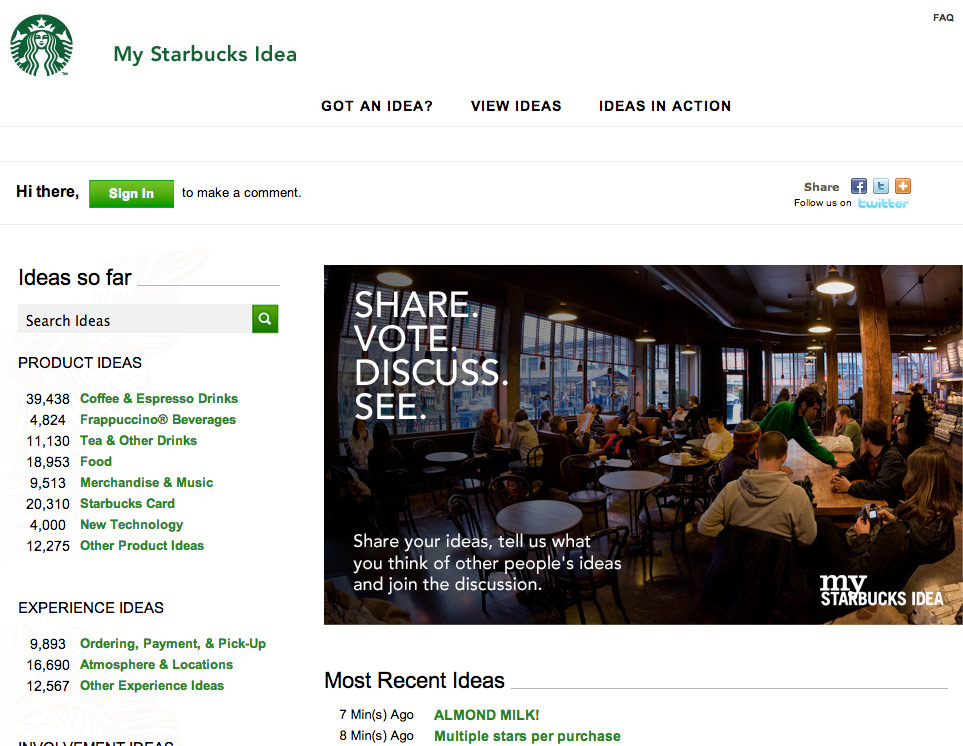
Starbucks built a community not just with their website about “My Starbucks Idea,” but like Apple, it is the very foundation of their entire business model.
As the founder and CEO of Starbucks, Howard Schultz, said “We’re in the people business serving coffee, not the coffee business serving people.”
Build your community by creating a compelling why that drives your business forward and enrolls people into your vision for the world. Do this and your tribe will promote your business without you even having to ask for it.
13. What Is Hot Off the Press?
Memory is fickle.
One minute people are concerned with earthquakes. The next it is a forgotten memory that doesn’t rear its ugly head until the next time there is an earthquake. That is why earthquake insurance sales are highest right after an earthquake, despite the fact that the risk of an earthquake is the lowest after one occurs.
People ignore scientists’ warnings of earthquakes and buy insurance only when the risk is minimal.
Strange, isn’t it?
But that’s just how we function. Daniel Gardner, the author of The Science of Fear, says “recent, emotional, vivid, or novel events are all more likely to be remembered than others.”
We react to what is most prevalent in our minds. And where are we getting the information that sticks in our minds?
The media.
Jonah Berger, the bestselling author of Contagious: Why Things Catch On says “if something is top-of-mind it will be tip-of-the-tongue. Just like peanut butter reminds us of jelly, the more we’re triggered to think about a product or idea, the more we’ll talk about it.”
Actionable Takeaway
Tie current events or celebrities that are currently on the top of people’s minds into your marketing to create triggers that make people remember your product.
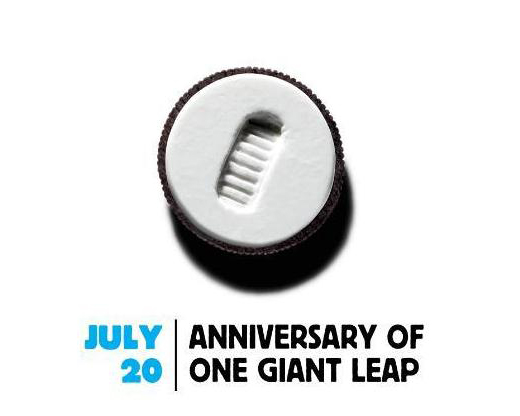
Here you can see how Oreo cookies tied the Mars Rover landing and the anniversary of the moon landing into their marketing. These events were on the top of people’s minds anyway, but now when they think of these events, they will be more likely to think of Oreo cookies as well.
Check out this article to learn more about Oreo’s marketing campaign.
What current events could you use in your marketing campaign?
14. Implement Scarcity
As it has been established, we look to others to determine what action to take. So the less there is of something, the more people perceive it to be a highly valued commodity, which in turn means that the more they will want to buy it.
You don’t want your audience to think that your product is for only an elite few at first and will open up to “normal” people at a later date.
To use scarcity in your marketing, eliminate any possibility of future abundance in the minds of your prospects. Either maintain the scarcity or gradually increase the level of abundance, without revealing it to your audience ahead of time.
Some other ways to use scarcity in your marketing are to put a countdown clock on your product page, create a limited number of products in a given time frame, or create a limited level of access.
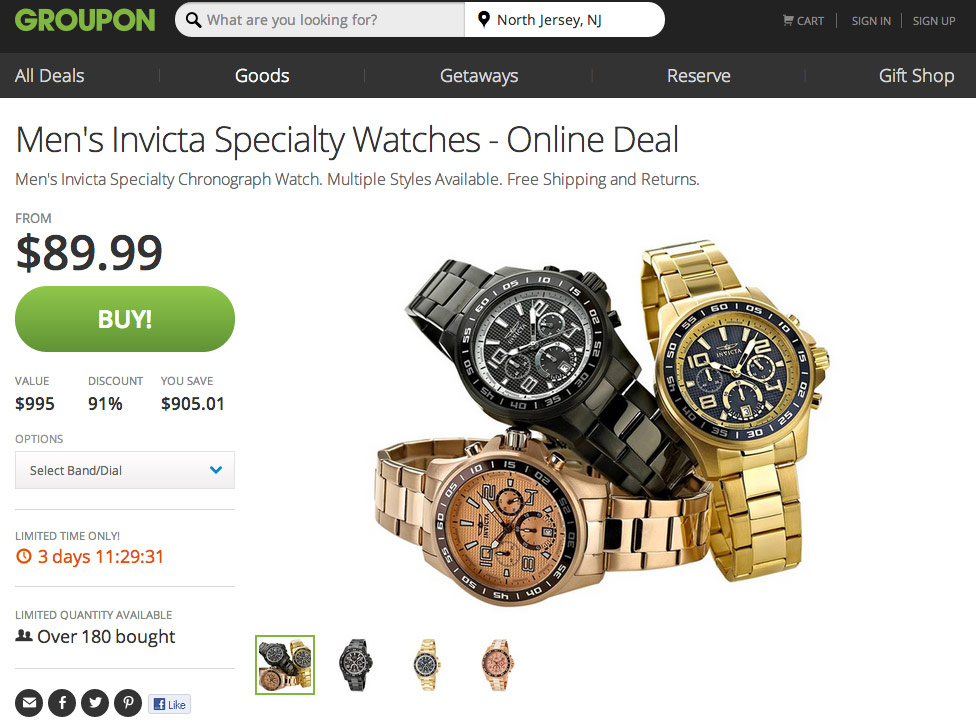
Groupon does this with every single product. Right under the buy button, it says “limited time only,” with a countdown clock. So I know that if I want to buy this product, I have to act now.
15. Build Controversy
In his research, Jonah Berger, the aforementioned bestselling author ofContagious, found that too much controversy turns people away, but small amounts draw people in.
He discovered that “controversy increases likelihood of discussion at low levels, but beyond a moderate level of controversy, additional controversy actually decreases likelihood of discussion.”
Tim Ferris says “Study the top stories at Digg or MSN.com and you’ll notice a pattern: the top stories all polarize people. Do not try to appeal to everyone. Instead, take a strong stance and polarize people. If you make it threaten people’s 3 Bs — behavior, belief, or belongings — you get a huge virus-like dispersion.”
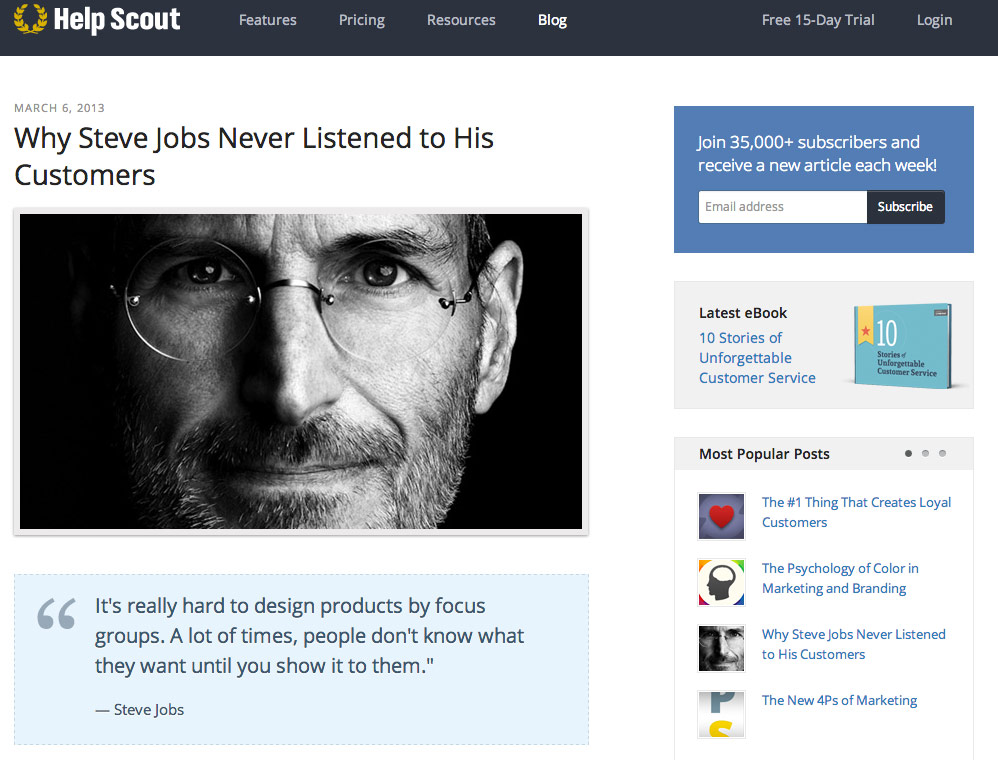
This is a great example of how HelpScout used a controversial headline to draw readers in. Most people would be outraged at that headline, because it challenged one of the 3 B’s.
Challenge one of the 3 B’s, behavior, belief, or belongings, and you will immediately draw people into your marketing message.
Like any of the above triggers, get creative with this one. Think about your audience and what their beliefs are. Challenge some of those beliefs or align with them to polarize the other side of the argument.
Remember, avoid politics, race, and religion, but everything else is fair game.
What other psychological triggers have you used in your business to generate sales? If you are struggling with implementing any of the above triggers in your business or have any questions about how to do so, post them in the comments below and I promise to answer every single one of them.
About the Author:Akshay Nanavati is a Marine Corps veteran of the war in Iraq, an adventurer, and an entrepreneur that reads over a book a week on psychology and marketing. Check out his free step-by-step training that reveals even more about how to use psychology to grow your business online. Why should you? Because it will help you increase conversions and improve sales.